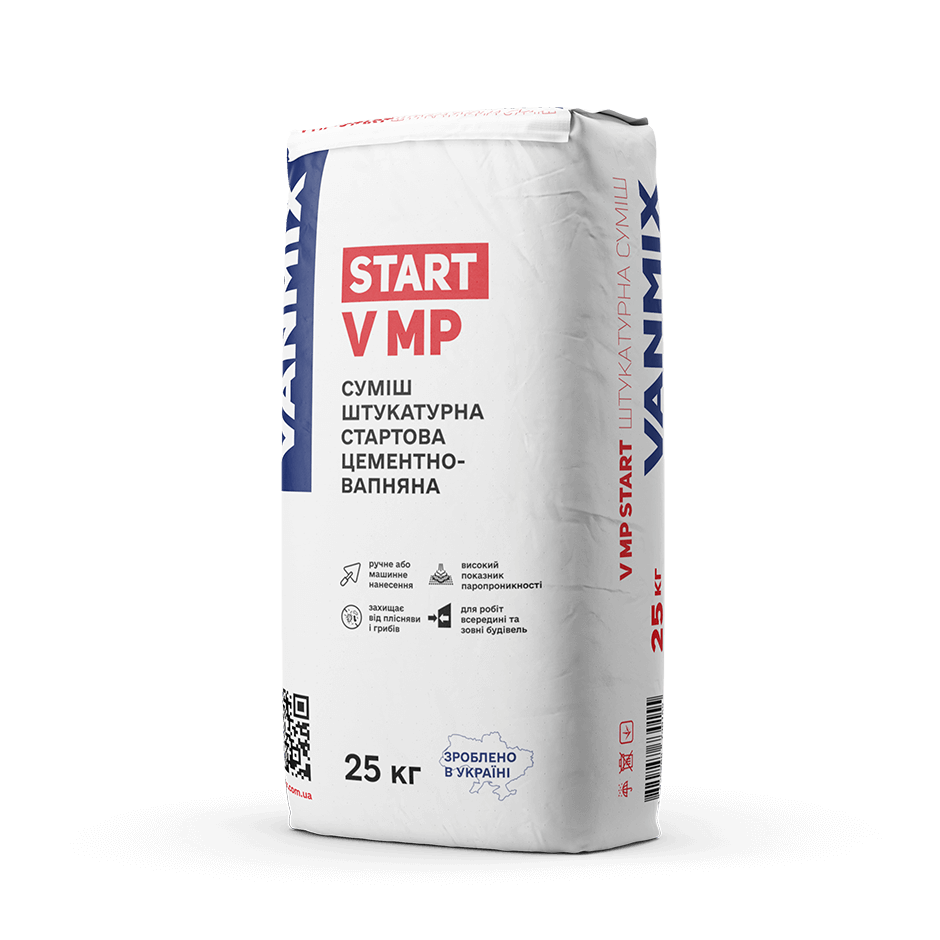
Plaster starting cement-lime mixture — V MP START
Starters
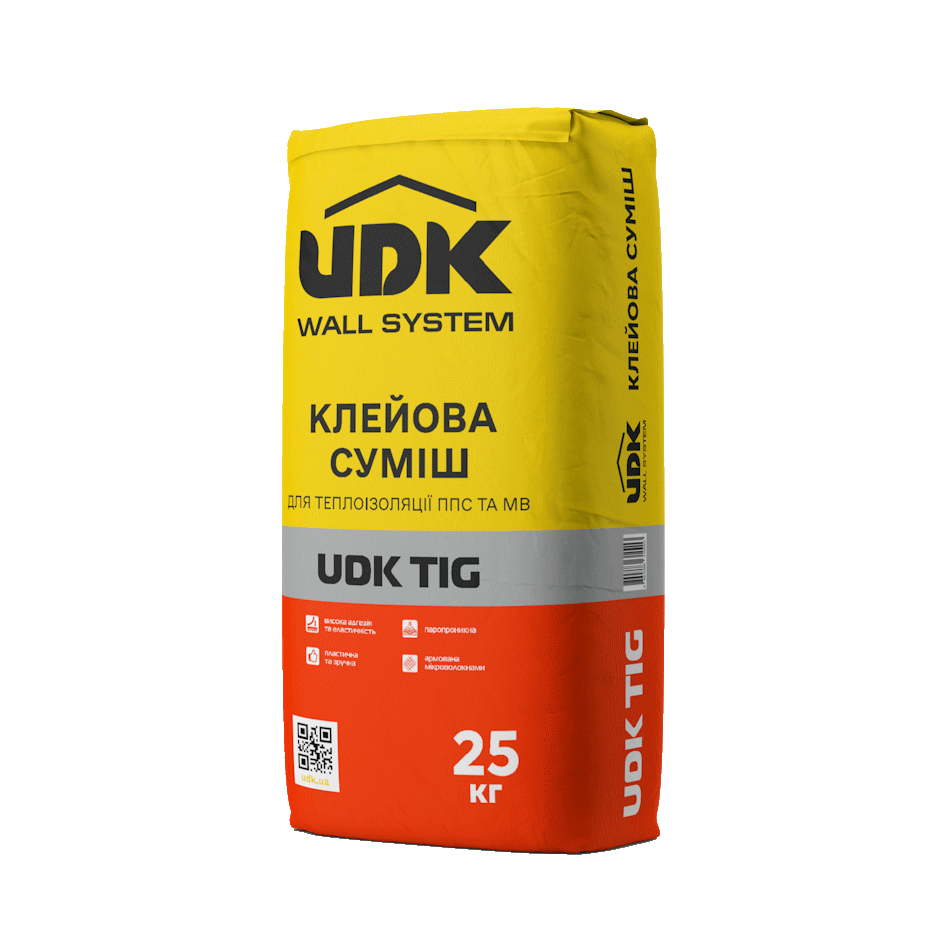
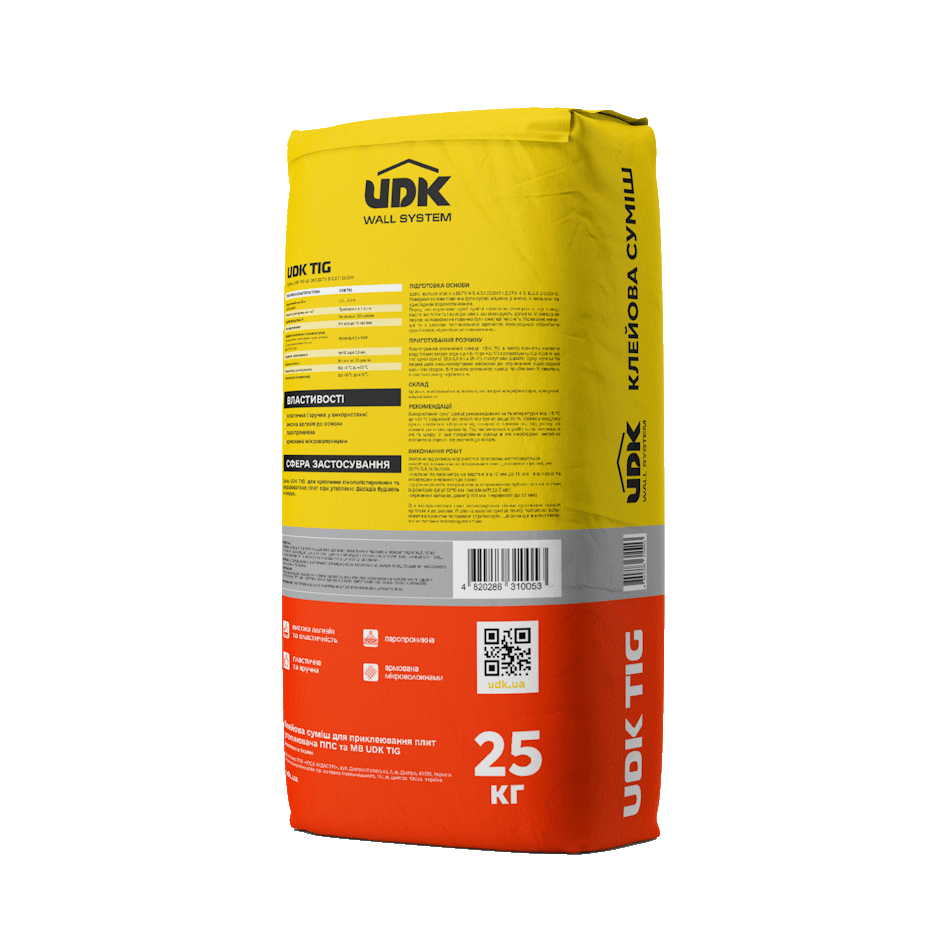
Field of application:
For gluing facade polystyrene and mineral wool insulation plates. The mixture is used for all facade insulation systems using the «light wet» method for gluing insulation boards (polystyrene foam and mineral wool).
Features:
Advantages:


5.0....6.0 l.

| Storage |
Cement, mineral fillers, polymer modifiers, reinforcing microfibers |
|
Water consumption per 25 kg (kg) of dry mixture, l (l) |
5.0....6.0 |
|
Consumption of dry mixture per 1 m² (m2) with a layer thickness of 1 mm (mm) |
Approximately 1.6 kg (kg) |
|
Consumption of dry mixture per 1 m² (m2) |
Approximately 4.5-6.5 kilograms (kg) |
|
Expiry date, min (min) |
At least 120 |
| Adjustment time, min (min) | At least 15 |
|
Adhesion strength to the base after endurance in air-dry conditions, MPa (MPa) |
Not less than 0.5 |
| Coarseness of aggregate, mm (mm) | Not more than 0.8 |
|
Frost resistance, cycles |
At least 50 |
It is carried out in accordance with DSTU-NB A.3.1-23:2013 and DSTU-NB B.2.6-212:2016. The surface of the base must be dry, strong, even, with low and uniform water absorption. Before applying the dry mixture, the surface is cleaned of dust, oil stains and other substances that reduce adhesion. In winter, there should be no ice or snow on the surface. Surfaces that are weak and highly absorbent should be pre-treated with primers, according to the purpose.
Preparation of mortar mixture: pour water into a clean container (water temperature from +15 °C to +25 °C) at the rate of 0.2-0.24 l (l) per 1 kg (kg) of dry mixture (5.0-6 .0 l (l) per 25 kg (kg)), gradually add the dry mixture and mix with a low-speed mixer until a homogeneous mass without lumps is obtained. After 5 minutes mix again.
The use of dry mixture is recommended at temperatures from +5 °C to +30 °C and relative air humidity not higher than 65%. The freshly laid mixture must be protected from rapid drying, from rain and direct sunlight. Eyes and skin should be protected during work. If the mixture gets into the eyes, it is necessary to immediately wash them with water and consult a doctor.
Add a 25 kg bag of dry mixture gradually to a container with 5-5.5 liters of clean water (water temperature from +15 °C to +20 °C), mix using a construction mixer until a homogeneous mass is formed. Leave for 5 minutes and mix again. The time of use of the mixture after mixing with water is about 2 hours. Before starting the work on the insulation of the building, it is necessary to fix the plinth along the perimeter of the base with the help of dowels at the bottom mark. Gluing polystyrene plates. Depending on the unevenness of the surface of the enclosing structures of the facade, choose one of the methods described below for gluing polystyrene plates.
Solid - if the surface of the wall has no visible irregularities (up to 3 mm per 1 m), the mortar mixture is applied continuously over the entire surface of the heat-insulating material slab at a distance of 10 to 15 mm from the edge with a toothed spatula with a tooth size of 10 x 10 mm.
Striped - if the surface of the wall has irregularities from 3 to 5 mm per 1 m, the mortar mixture is applied to the surface of the slab in the form of strips at a distance of 10 to 15 mm from the edge along the entire perimeter of the slab and in the middle. The strips applied around the perimeter should have gaps so that air jams do not form during the gluing of the plates.
Beacon — if the surface of the wall has irregularities of 5 to 10 mm per 1 m, the mortar mixture is applied to the surface of the slab in the form of beacons at the rate of 5–8 pieces with a diameter of about 100 mm per slab measuring 0.5 x 1.0 m. Gluing mineral wool slabs is performed only by the continuous method. For better adhesion of heat-insulating plates to the surface, it is recommended to combine strip and beacon methods.
Apply the mortar mixture to the plate and immediately install it in the design position and press it down. The force during pressing should be such that the solution mixture is distributed between the surface and the slab by at least 60%. After applying the mortar mixture, the slab must be installed in the design position and pressed, the position of the slab can be adjusted within the next 10 minutes. The plates must be glued tightly to each other in the same plane, preventing vertical seams from overlapping. The width of the seams should not exceed 2 mm. Remains of the solution mixture should be removed before it hardens with a spatula. 2 days after gluing, it is necessary to start additional mechanical fastening of the polystyrene plates with facade dowels and the installation of a waterproof reinforced layer. It is not allowed to carry out work during precipitation, strong wind, direct sunlight, without special protective structures that limit the influence of atmospheric factors.
Paper bags with an inner polyethylene layer of 25 kg.
The mixture must be stored in the company's airtight packaging in a dry room, on pallets. The shelf life is 12 months from the date of manufacture indicated on the package.
On average, 4-6 kg of glue is used per 1 m2, depending on the thickness of the applied layer and the condition of the surface.